

Benchmarking is for Losers.
Don’t get mad at me here. Roger Martin said it. I just love it and agree with him.
He has a more complex way — hello Production Possibility Frontier — to say that benchmarks are usually about the collective middle and not about the optimal or ideal and certainly not tailored to you.
Which isn’t to say they’re useless…
Saying that benchmarking is for losers doesn’t mean it isn’t useful. If you are a loser, it is helpful to become less of a loser. If you are in that position and use benchmarking assiduously, you might get all the way to mediocre!
So yeah, if you want to be mediocre, go for it. Benchmark your face off and work towards the middle. But, as Roger points out in his post, by the time you get there the ‘best practice’ you are chasing has probably shifted again and you’re constantly playing catch-up.
Sound familiar?
So as someone who loves a benchmark and responsible for creating more than a few of them…
What are some common pitfalls to avoid when it comes to benchmarks?
They don’t know your context so you better know theirs.
Is the data set relevant to your category? Your size? Your focus? It’s nearly impossible to find a perfect benchmark data set to fit exactly you and your brand but try to understand where the data is coming from and how it differs from your own.
There are 1.8 M nonprofits in the US alone. So a ‘nonprofit’ benchmark could mean a lot of things. I try to think about ‘swathes’ within the industry rather than pure categories where you can use 2x2 matrices to plot organizations.
For example, think of size on one axis — large (bigger than $10M) and small (less than $10M) — and then if they have significant fee for service or earned revenues on the other.
It would look like this:
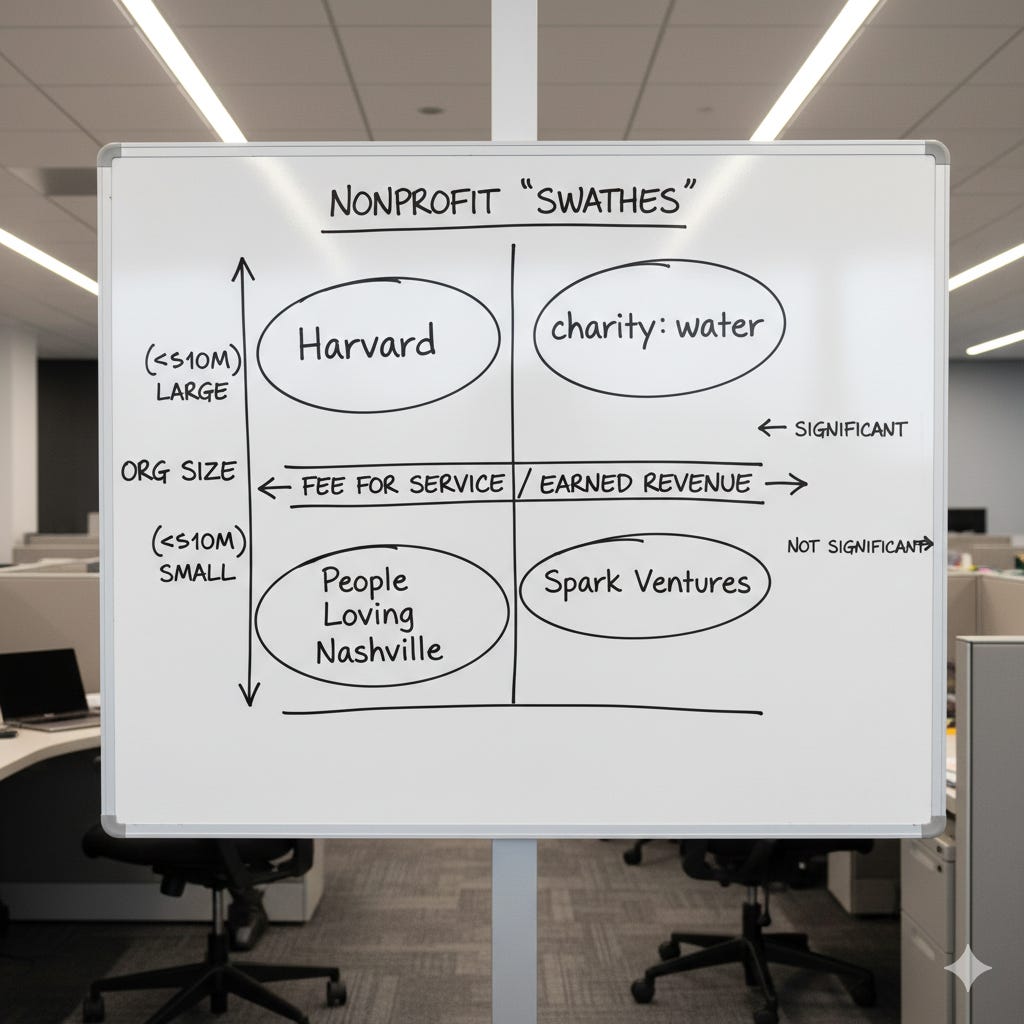
So you can see that charity: water here isn’t really in the same arena as say Harvard University or Spark Ventures (my first job out of grad school) or People Loving Nashville. This isn’t to say you can’t learn from organizations in other quadrants but it at least embraces the fact that there are significant differences for how each quadrant goes about its marketing and fundraising.
And for the benchmark, if you can, try to understand which quadrant it skews. Most list the organizations used in the benchmark so you can copy and paste into an AI tool and quickly analyze if the report doesn’t tell you themselves.
You need to know the context behind the benchmark to apply it properly (if at all) to you and yours.
The numbers or experiences aren’t targets… they’re numbers and experiences.
When I was at NextAfter, I led multiple benchmarks focused on the user experience using a ‘mystery shopper’ methodology. We tried to create data to quantify experiences to get a better picture of not just what was happening but how organizations were going about things. I think it was, and is, a useful contribution to our space but because the average nonprofit sends 3 emails within the first 30 days doesn’t really mean much to you now does it? Or it shouldn’t.
So don’t treat benchmarks as a target or destination or inherently good or bad. It’s just another data point that needs to be interpreted and used properly.
M+R Benchmarks is one of the best, if not the best, in the nonprofit space for digital marketing and fundraising. But the same logic applies.
The average cost to acquire a donor on Meta via ads is $106. But what was the average gift? Was it a monthly gift? How was the retention and LTV? Even with a “good” piece of information, there are more questions and nuances.
So the target isn’t to get donors via Meta at less than $106. It’s to get as many high value donors as cheaply as you possibly can that fits your strategy.
Benchmarks aren’t targets or goals but another data point to consider. That’s it.
How can you better use benchmarks?
See where you’re ahead and double down.
Instead of looking at where you’re lagging and how to catch up, see where you’re ahead and see how you can get further ahead. This embraces the idea that you have dominant strategies, campaigns, or creatives that produce the majority of your outputs which, generally speaking, is true.
Let’s use a real world example and a benchmark. charity: water acquires donors primarily with ads today and significantly more effectively than the average organization in the M+R Benchmark. They’re also fairly behind when it comes to email fundraising. A traditional benchmarking approach would say “there’s room to improve in email, we’re doing great in paid ads” and they wouldn’t be wrong per se but a better winning strategy would be to double and triple down on a strength (paid ads) and worry less where you are behind (email).
Strategy — how you can ‘win’ without infinite resources — is mostly about saying what you won’t do or what you’ll do less of to give yourself more chances to have big successes. It’s not about risk mitigation, diversification, or balance.
Try to see where you’re ahead and press into your advantage.
See where others have gaps and fill them.
Rory Sutherland coined the term “Reverse Benchmarking” which is essentially this approach so I’ll let him explain it with a shoutout to via Will Guidara and his book Unreasonable Hospitality.
And here he is explaining it via Buc-ee’s and their strategy around washrooms.
In the nonprofit context, this is a lot of what charity: water has done without always intentionally using this as a strategy.
Nonprofits weren’t great at being transparent with how funds were used or the impact smaller donors had… enter the 100% model and commitment to proving every project.
Nonprofits weren’t great at design, creative, marketing, and UI/UX… enter a significant focus on and investment in design, creative, marketing, and UI/UX through staffing and prioritization.
Nonprofits weren’t great at providing a meaningful way for people to use their networks and influence in a digital world… enter mycw, peer-to-peer fundraising, and the birthday fundraiser.
What’s essential for this strategy though is that the gap that you try to fill has meaningful value for your customer. Not just you. And not just gap.
A beer sommelier isn’t just unique, but is a great addition to beer connoisseurs. Clean washrooms matter a lot to people traveling (especially with kids).
And trusting a charity, with a brand you want to be associated with, that empowers you to do something good in the world is meaningful to people.
Find what’s meaningful to consumers and where others are poor and see if you can create products and experiences to fill that gap.
Use as guardrails to operate within and set context.
Let’s go back to the M+R Benchmark and a handy chart. How much are organizations investing in digital advertising compared to their revenues.
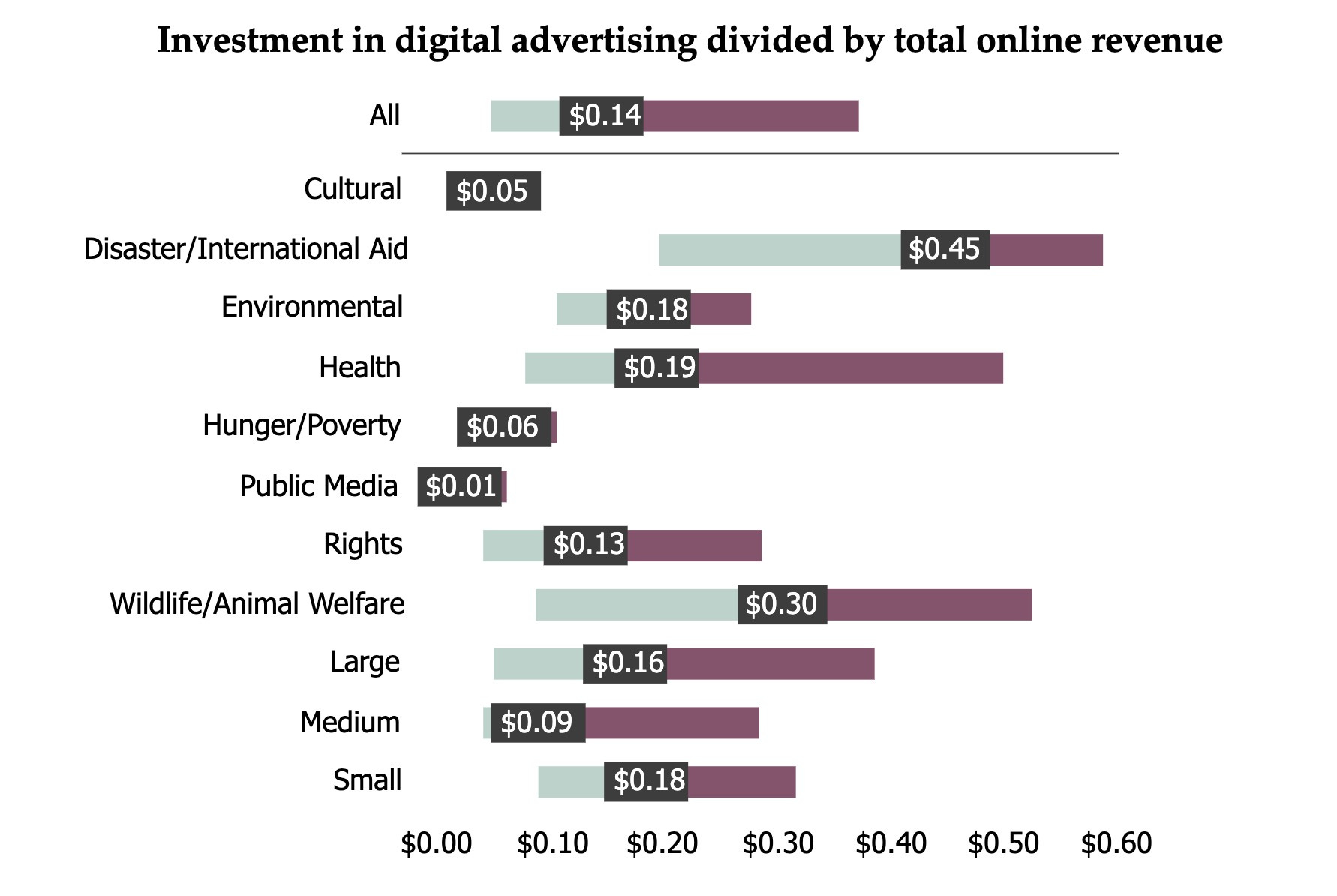
This is a helpful chart because it splits out with some ‘swathes’ like size and category. So charity: water can look at Large and Disaster/International Aid to get a sense of what ‘peers’ are spending.
But it also has a min and max. This is super helpful. The lowest amount a Disaster/International Aid organization is spending on digital ads as a percent of their total online revenue is ~$0.20 and the max is ~$0.60 with the average being ~$0.45.
None of this says what’s good or bad or right or wrong. But as you build your strategy and budget you should probably be investing at least ~$0.20 to have any chance to keep pace with peers. And if you want to be aggressive to fuel growth in this way, you’d need to spend more like ~$0.60.
So now you have a ballpark and some guardrails to have conversations with but again, these aren’t targets to achieve or recommendations. It still takes interpretation. Here’s a real internal email discussion around this very benchmark for charity: water.

Use benchmarks to know existing minimums and maximums to help shape conversations and plans.
Wrapping Up
Benchmarks aren’t about strategy. They are often overused and abused leading to many ‘middle of the road’ ideas and approaches.
You have to know the context of the benchmark and how it applies to yours.
Use benchmarks to find meaningful gaps and fill them.
See where you’re ahead and double down.
Use benchmarks to set a ballpark to have conversations around.
What are some benchmarks I use?
M+R Benchmarks - the best available for digital marketing and fundraising for nonprofits
donorCentrics Sustainer Summit - for larger, subscription giving focused nonprofits
Fundraising Effectiveness Project - for as close to ‘real-time’ data that we can get
Paddle Saas Quarterly Reports - for macro trends in the subscription world across B2B and DTC